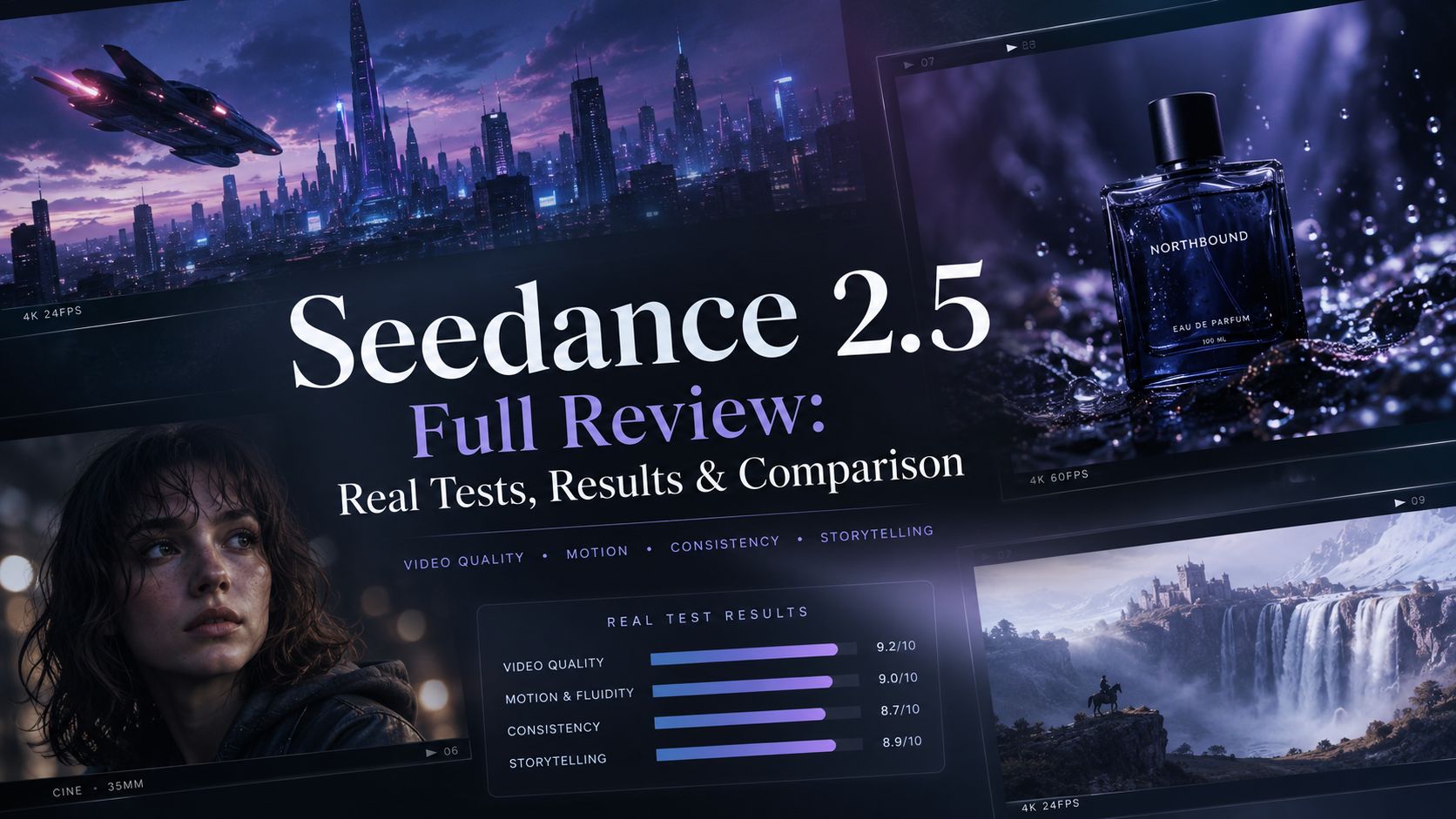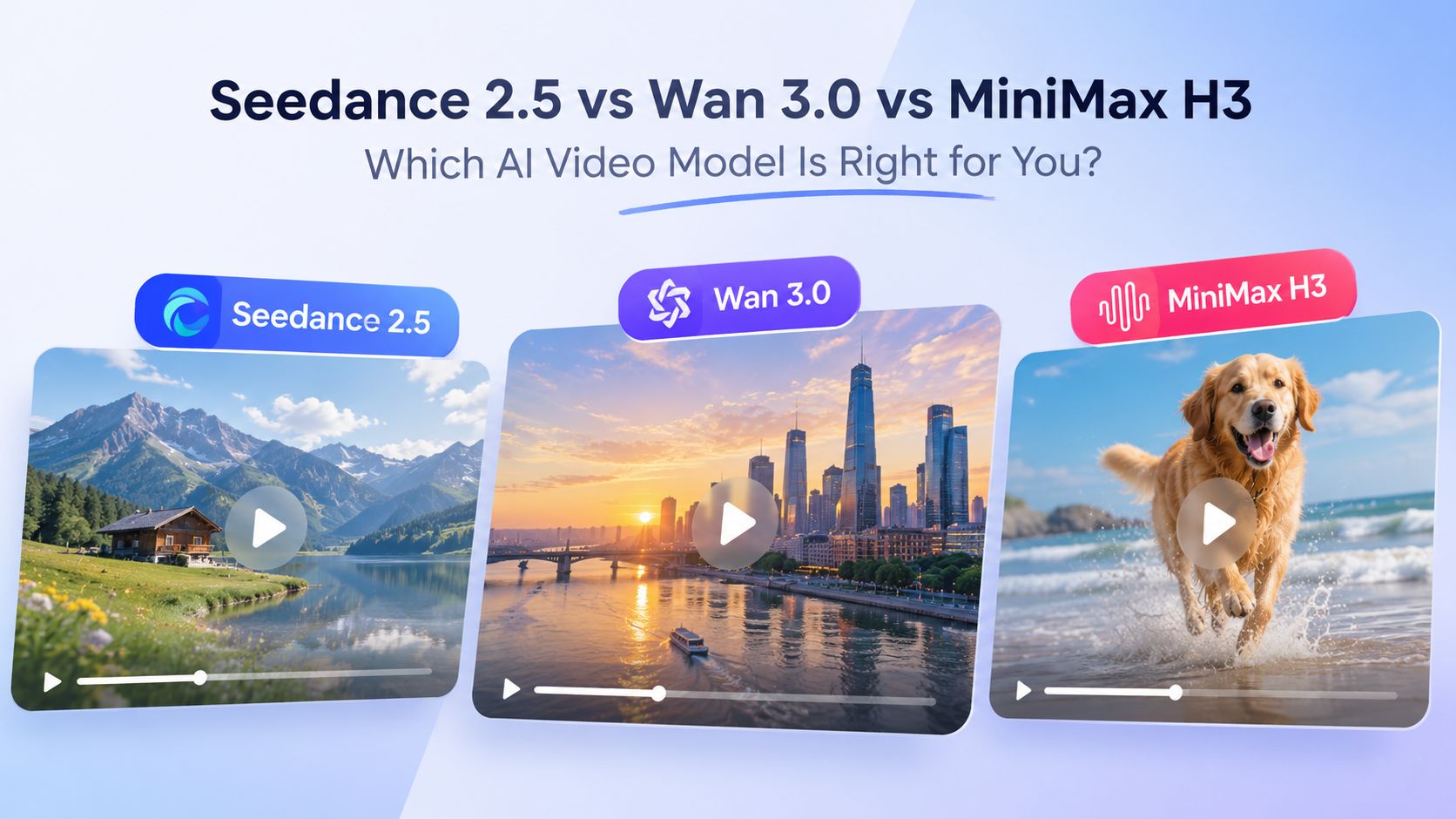
Seedance 2.5 vs Wan 3.0 vs MiniMax H3: Which One Actually Wins?
Seedance 2.5, Wan 3.0, and MiniMax H3 are three of the newest AI video models competing for creators’ attention, each promising better motion, stronger consistency, native audio, and more complete video generation. But specs alone do not tell you which one works best in practice. In this comparison, we put all three through the same real-world tests and prompts to see how they compare in video quality, motion, audio, and consistency—and which model is best for different creative needs.

Table of Content
Seedance 2.5 vs Wan 3.0 vs MiniMax H3: Quick Comparison
On paper, these three models are surprisingly close, but they take different approaches. Seedance 2.5 puts more emphasis on longer storytelling, reference control, and editing, while Wan 3.0 combines 30-second generation with flexible multimodal inputs and native audio. MiniMax H3 is limited to shorter clips, but offers up to 2K output, stereo audio, and strong multimodal control.
|
|
Seedance 2.5 |
Wan 3.0 |
MiniMax H3 |
|
Max duration |
Up to 30s |
Up to 30s |
Up to 15s |
|
Resolution |
— |
Up to 1080p |
Up to 2K |
|
Native audio |
Yes |
Yes |
Yes, stereo |
|
Reference input |
Image, video, audio |
Image, video, audio, document, web page |
Image, video, audio |
|
What stands out |
Long-form storytelling and precise control |
Flexible input and complete 30s creation |
High-resolution output and multimodal control |
If you want the short answer:
- Best for longer storytelling and control: Seedance 2.5
- Best for flexible multimodal creation: Wan 3.0
- Best for shorter, high-resolution clips: MiniMax H3
Specs only tell part of the story, though. A longer duration or higher resolution does not necessarily mean a better final video. The bigger question is how well each model handles the same creative task—which is what we tested next.
Seedance 2.5 vs Wan 3.0 vs MiniMax H3: Real-World Tests
Specs can show what each model supports, but they do not reveal how well those features hold up in an actual generation. We therefore tested Seedance 2.5, Wan 3.0, and MiniMax H3 across four different scenarios, using the same creative brief wherever possible.
Test 1: Character Consistency and Human Motion
Our first test focused on a realistic human scene with multiple actions in sequence. The character needed to move through the scene, interact with an object, turn toward the camera, and maintain the same face, clothing, and overall appearance throughout the clip.
This test mainly looks at facial consistency, hand and body movement, action continuity, and whether the character starts to drift as the scene becomes more complex.
Test prompts:
A realistic 10-second cinematic video of a young woman with shoulder-length dark brown hair, wearing a white fitted T-shirt, blue jeans, and white sneakers in a bright modern apartment. Keep her face, hairstyle, clothing, and body proportions completely consistent throughout the shot.
0–2s: She walks quickly into the living room from the left side of the frame and approaches a chair with a light jacket and small shoulder bag resting on it.
2–4s: Without stopping for long, she bends down naturally, picks up the jacket with one hand and the bag with the other, then straightens back up.
4–6s: She slips one arm into the jacket, swings the jacket around her shoulders, and puts the other arm through the sleeve while taking two steps forward.
6–8s: She places the shoulder bag over her shoulder, adjusts the strap with one hand, then quickly turns around toward the camera.
8–10s: She takes two more steps toward the camera, brushes a loose strand of hair away from her face, and gives a brief natural smile.
Use one continuous medium-wide tracking shot with subtle natural camera movement. Movements should feel quick but realistic, with correct body balance, hand-object interaction, fabric movement, and natural arm and leg coordination. Keep the same face and identity through walking, bending, partial occlusion, dressing, turning, and approaching the camera. No cuts, no extra people, no duplicated limbs, no changing clothes or facial features.
True performance of Seedance 2.5:
True performance of Wan 3.0:
True performance of Minimax H3:
Test 2: Action, Physics and Camera Movement
The second prompt introduced faster movement, physical interaction, and a more dynamic camera. This makes it easier to spot problems such as floating objects, broken contact between characters, unnatural body movement, or camera motion that disrupts the scene.
Here, we compared how well each model handles complex action, spatial relationships, physical realism, visual effects, and camera control.
Test prompts:
A realistic 10-second cinematic basketball sequence on an indoor court. One athletic male player in a dark jersey drives toward the basket while a defender in a white jersey tries to stop him.
0–2s: The offensive player dribbles quickly with his right hand while moving forward, then makes a sharp crossover to his left to get past the defender.
2–4s: He accelerates toward the basket, keeping the ball under control as the defender turns and follows closely behind.
4–6s: The player gathers the ball with both hands, takes two strong steps, and jumps toward the rim for a layup.
6–8s: He releases the ball softly off the backboard. The ball hits the glass, changes direction naturally, and drops through the hoop while the player lands with balanced footwork.
8–10s: The ball bounces once on the floor beneath the basket as both players slow down and turn toward it.
Use one continuous dynamic tracking shot. Start from a low side angle near mid-court, move with the players during the drive, then slightly arc toward the basket during the jump. Keep the camera movement smooth and responsive to the action. Focus on realistic dribbling, hand-ball contact, footwork, body balance, defender spacing, jumping physics, ball trajectory, backboard impact, rim interaction, and natural landing. No scene cuts, no floating ball, no sliding feet, no duplicated limbs, no unnatural body collisions.
True performance of Seedance 2.5:
True performance of Wan 3.0:
True performance of Minimax H3:
Test 3: Dialogue, Audio and Lip Sync
For the third test, we used a dialogue-driven scene with spoken lines, environmental sound, and visible facial movement. Native audio is becoming a major part of modern AI video generation, but simply producing sound is not enough—the timing also needs to match what is happening on screen.
We looked at speech clarity, lip sync, sound timing, background audio, and how naturally the audio fits the scene.
Test prompts:
A realistic 10-second cinematic kitchen scene with two young adults cooking dinner together in a modern home kitchen. One person is chopping vegetables at the counter while the other stands beside the stove holding a plate.
0–2s: The first person continues chopping vegetables and says clearly, “Did you add the garlic yet?” Their lip movements should match the words naturally.
2–4s: The second person turns slightly toward them and replies, “Not yet, give me a second,” while placing the plate down beside the stove.
4–6s: The first person pauses chopping, looks up, and smiles briefly. The sound of the knife stopping should match the visual action.
6–8s: The second person adds garlic to the pan. A clear sizzling sound begins immediately as the garlic touches the hot surface.
8–10s: The first person says, “That smells much better,” while both continue cooking naturally.
Include realistic kitchen audio throughout: soft chopping sounds, light plate contact, subtle room ambience, pan sizzling, and natural spoken dialogue. Keep both voices distinct and synchronized with the correct speaker. Lip movements should match each line closely, and sound effects should occur exactly when the corresponding action happens. No background music, no overlapping dialogue, no delayed sound effects, no voice switching, and no unnatural mouth movement.
True performance of Seedance 2.5
True performance of Wan 3.0
True performance of Minmax H3
Seedance 2.5 vs Wan 3.0 vs MiniMax H3 Pricing
Price can vary depending on where you access each model, but the difference between the three is already noticeable. MiniMax H3 is currently one of the more affordable options per generated second, while Wan 3.0 scales its price by resolution. Seedance 2.5 pricing is less straightforward, as different platforms and subscription routes use different rates.
|
Model |
Current Pricing Reference |
Example |
|
Seedance 2.5 |
From $0.097/sec through eligible Dreamina launch plans |
Pricing varies by platform and region |
|
Wan 3.0 |
$0.05/sec at 480P, $0.10/sec at 720P, $0.20/sec at 1080P |
10s at 1080P ≈ $2.00 |
|
MiniMax H3 |
Around $0.09/sec at 768P, $0.13/sec at 2K |
10s at 2K ≈ $1.30 |
On price alone, MiniMax H3 offers strong value, especially if you want 2K output without generating a full 30-second sequence. Wan 3.0 can also be relatively inexpensive at lower resolutions, although a 30-second 1080P generation naturally costs more.
Seedance 2.5 is harder to compare directly because its current public pricing depends heavily on the access route. More importantly, the cheapest generation is not always the cheapest finished video. If one model needs several retries to get the right character, motion, or timing, its real production cost can quickly increase.
For that reason, we would look at cost per usable result, not just cost per second. The better value is ultimately the model that gives you a video you can actually use with fewer regenerations.
Which AI Video Model Should You Choose?
The best model depends less on the spec sheet and more on the kind of video you are trying to make.
Choose Seedance 2.5 if you want more control over longer scenes
Seedance 2.5 is the better fit for creators working on longer narrative videos, multi-step actions, and scenes that need stronger reference control. Its 30-second generation and broader reference support make it especially useful when continuity matters more than simply producing one polished shot.
Choose Wan 3.0 if you want a more flexible creation workflow
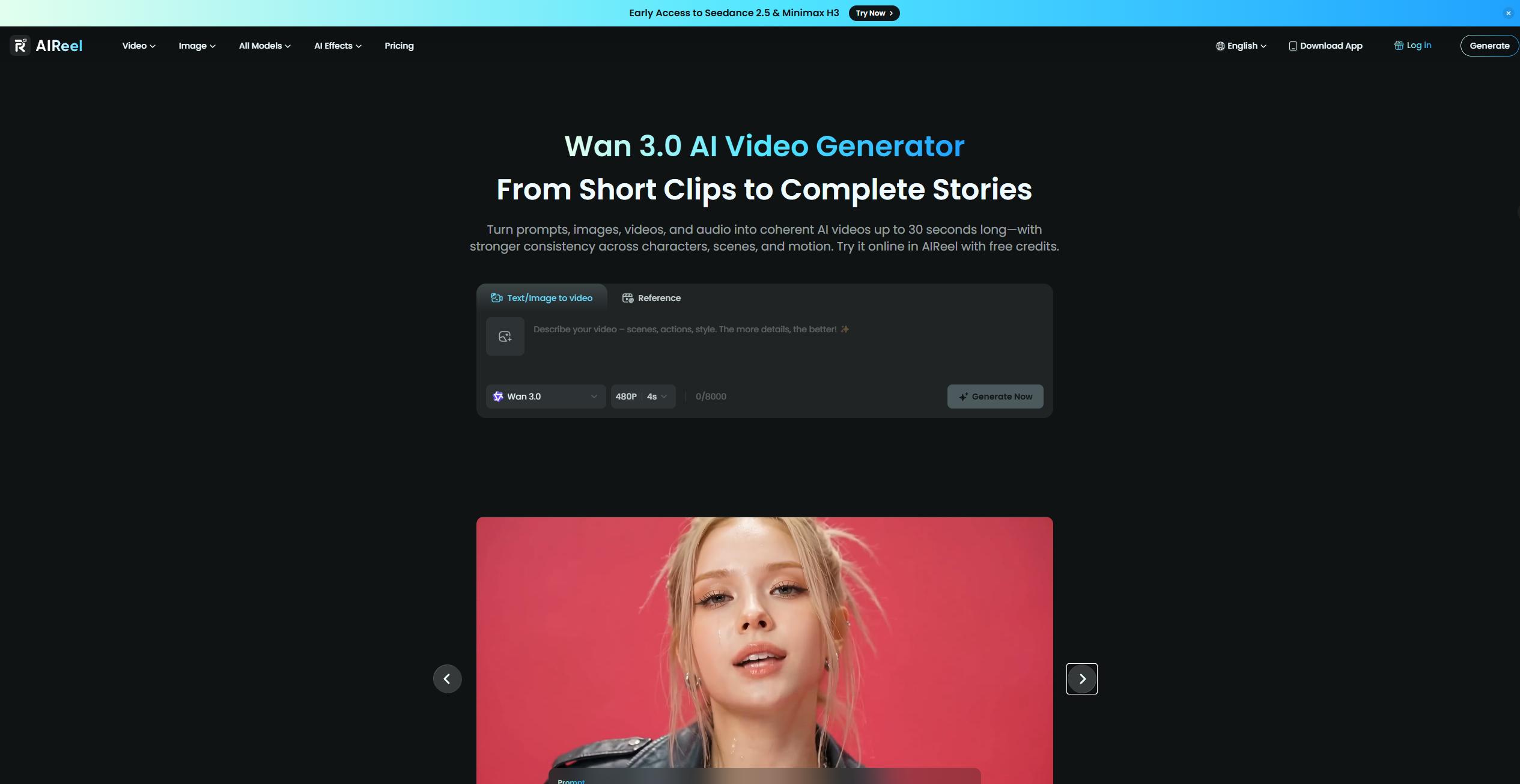
Wan 3.0 stands out for creators who want to work with different types of source material, including images, videos, audio, documents, and web content. It is a strong option for turning more complex inputs into complete video sequences, especially when a 30-second workflow is important.
Choose MiniMax H3 if you want shorter, high-quality clips
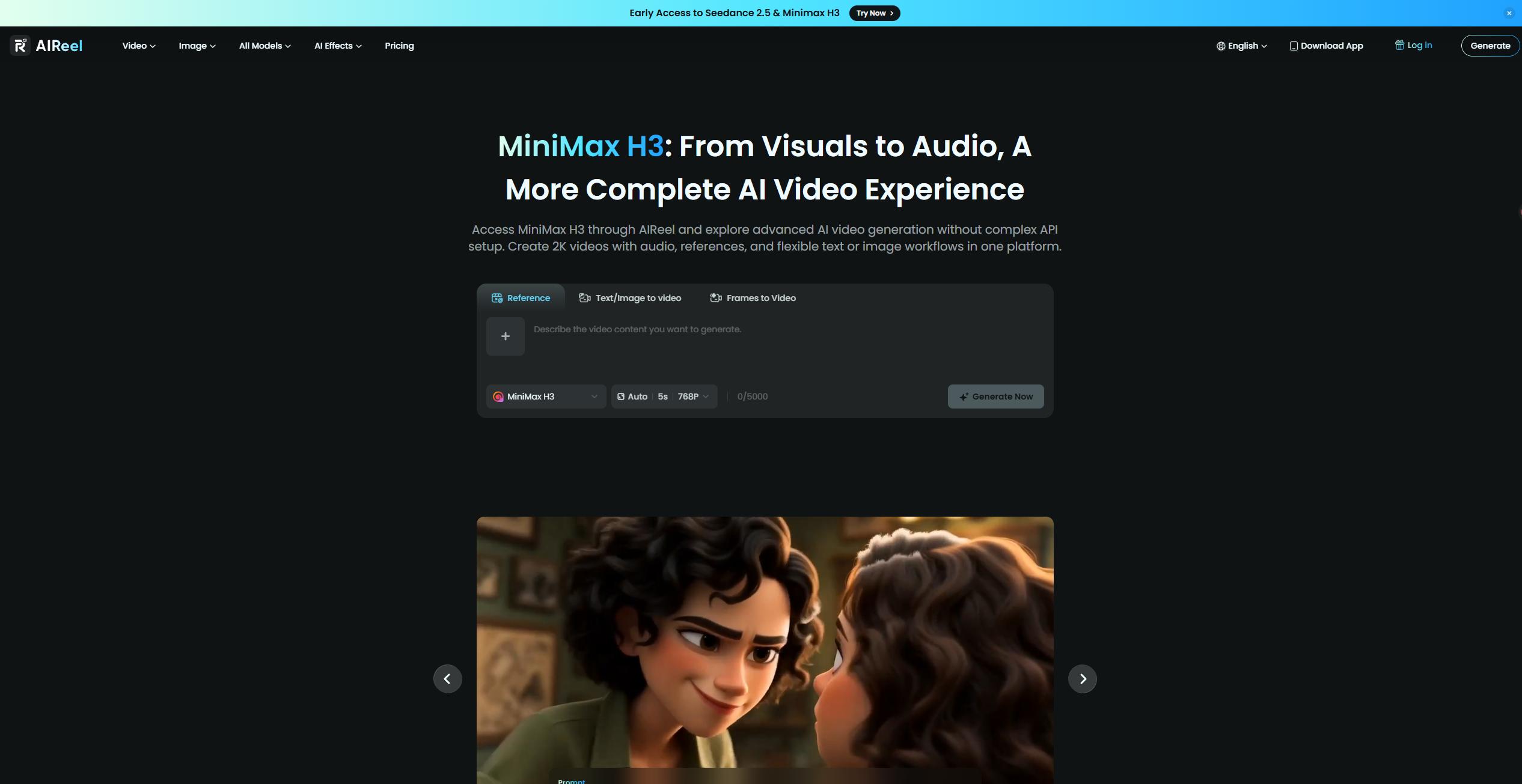
MiniMax H3 makes more sense for shorter videos where resolution, native audio, and polished output matter most. Its 2K support and stereo audio make it particularly attractive for social clips, dialogue scenes, and other projects that do not need a full 30-second generation.
There is no universal winner across every use case. Seedance 2.5 is stronger for longer and more controlled storytelling, Wan 3.0 offers the most flexible input workflow, and MiniMax H3 is highly competitive for shorter high-resolution clips. The right choice comes down to which of those strengths matters most for your project.
Try Seedance 2.5, Wan 3.0 and MiniMax H3 in One Place
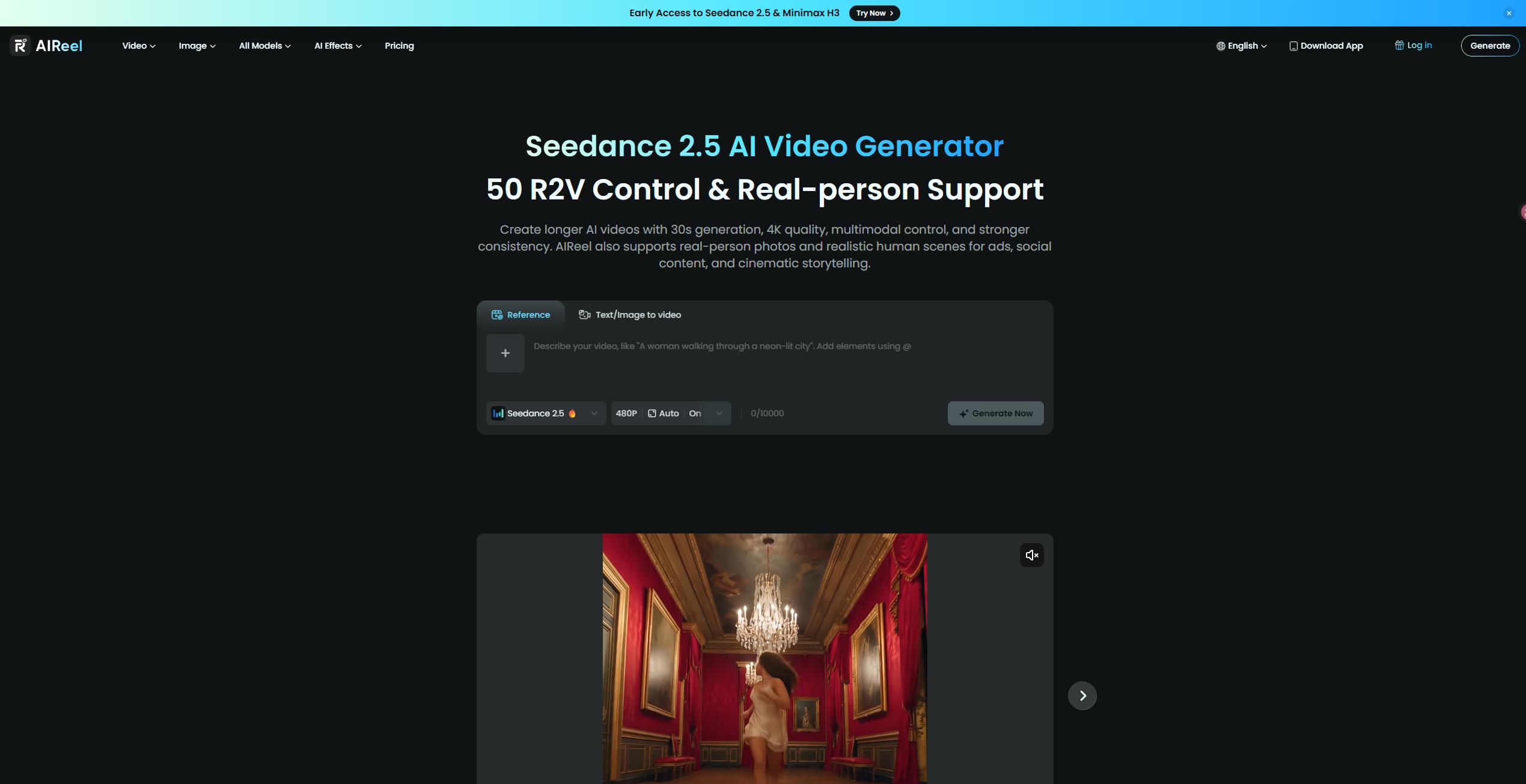
Still not sure which model fits your idea best? You do not have to choose based on specs alone. With AIReel, you can access leading AI video models from one platform, test the same prompt or image across different models, and compare the results for yourself.
AIReel brings together 20+ AI image and video models, along with text-to-video, image-to-video, and 1,000+ ready-to-use templates, so you can move from an idea to a finished video without jumping between different tools. Whether you want longer cinematic scenes, polished short clips, realistic motion, or native audio, you can switch models based on what each project needs.
Instead of asking which AI video model is best overall, try the same idea with different models and see which one works best for you.
FAQ: Seedance 2.5 vs Wan 3.0 vs MiniMax H3
Is Seedance 2.5 better than Wan 3.0?
It depends on the workflow. Seedance 2.5 is a strong choice for longer storytelling, reference control, and more structured scenes, while Wan 3.0 stands out for flexible multimodal inputs and 30-second video generation.
Wan 3.0 vs MiniMax H3: which is better?
Wan 3.0 is better suited to longer videos and broader input types, while MiniMax H3 is more attractive for shorter clips where 2K output, native stereo audio, and polished results are priorities.
Is Seedance 2.5 better than MiniMax H3?
Seedance 2.5 has an advantage for longer, multi-step scenes and more complex storytelling. MiniMax H3 is better suited to shorter high-resolution videos and projects where native audio quality matters more.
Which model is best for long AI videos creation?
Seedance 2.5 and Wan 3.0 both support generation up to 30 seconds, making them better options for longer sequences. MiniMax H3 currently supports shorter clips of up to 15 seconds.
Which model has the highest video resolution?
MiniMax H3 supports output up to 2K, while Wan 3.0 supports up to 1080p. Resolution alone, however, does not determine overall video quality, so motion, consistency, and prompt accuracy should also be considered.
Which AI video model is best for character consistency?
There is no universal winner for every prompt. Character consistency can vary depending on the reference image, scene complexity, duration, and amount of movement, which is why testing the models with the same source material gives a more useful comparison.
Which model is better for AI videos with audio?
All three models support audio generation, but they approach it differently. MiniMax H3 places particular emphasis on native stereo audio, while Seedance 2.5 and Wan 3.0 are also designed for synchronized audiovisual generation.
Which is cheaper: Seedance 2.5, Wan 3.0, or MiniMax H3?
Pricing depends on resolution, duration, and the platform used to access each model. MiniMax H3 can be cost-effective for shorter high-resolution clips, while Wan 3.0 offers different pricing tiers by resolution. The more useful comparison is often the cost of getting a usable result rather than the price of a single generation.
Conclusion
In this Seedance 2.5 vs Wan 3.0 vs MiniMax H3 comparison, each model shows clear strengths in areas like video quality, control, audio, and longer-form creation. There is no single best choice for every project, so the most practical approach is to test them with your own prompts. With AIReel, you can access multiple AI video models in one place and quickly compare which one fits your creative needs best.