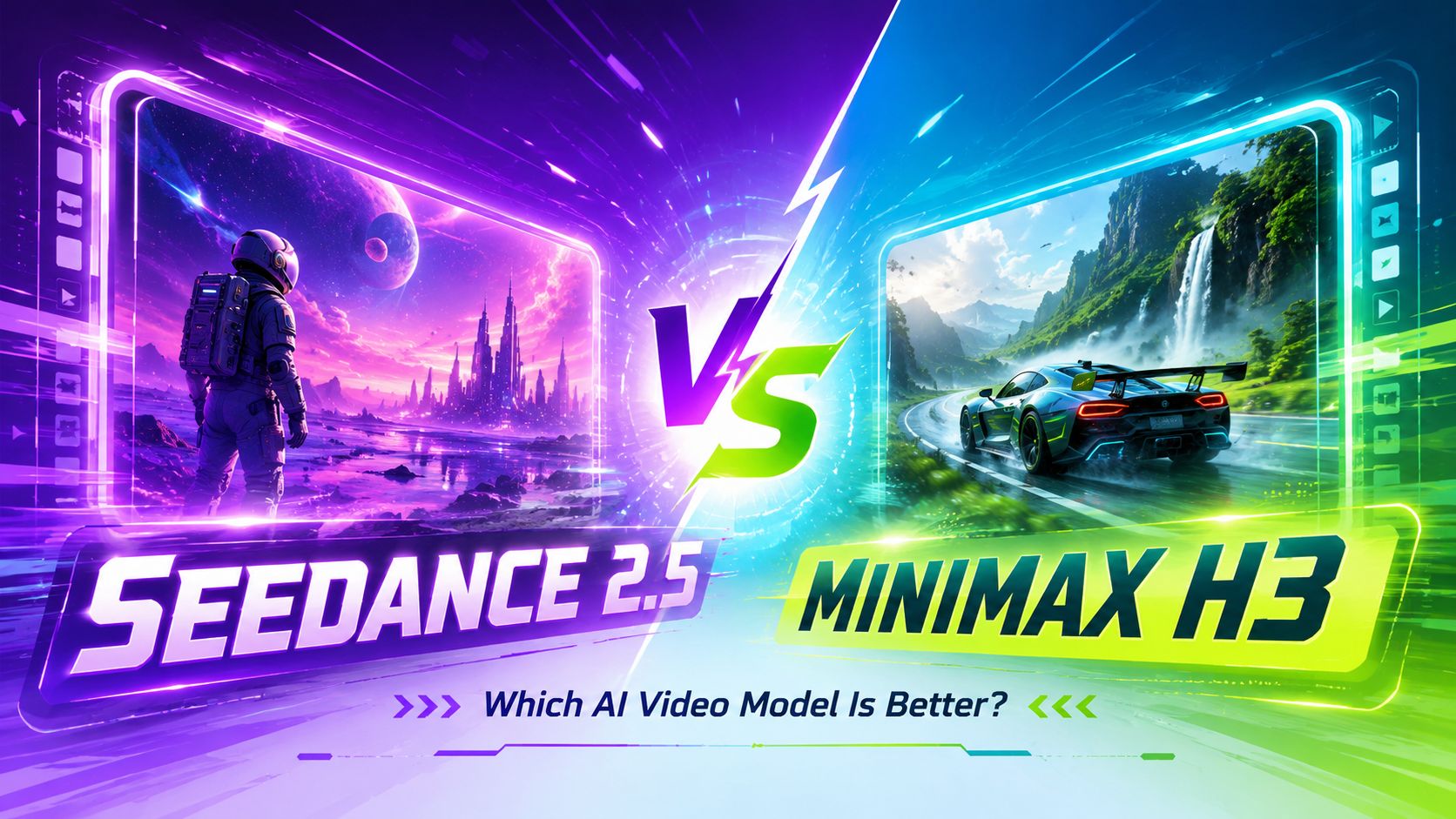
Seedance 2.5 vs MiniMax H3: A Latest Real-World Video Test
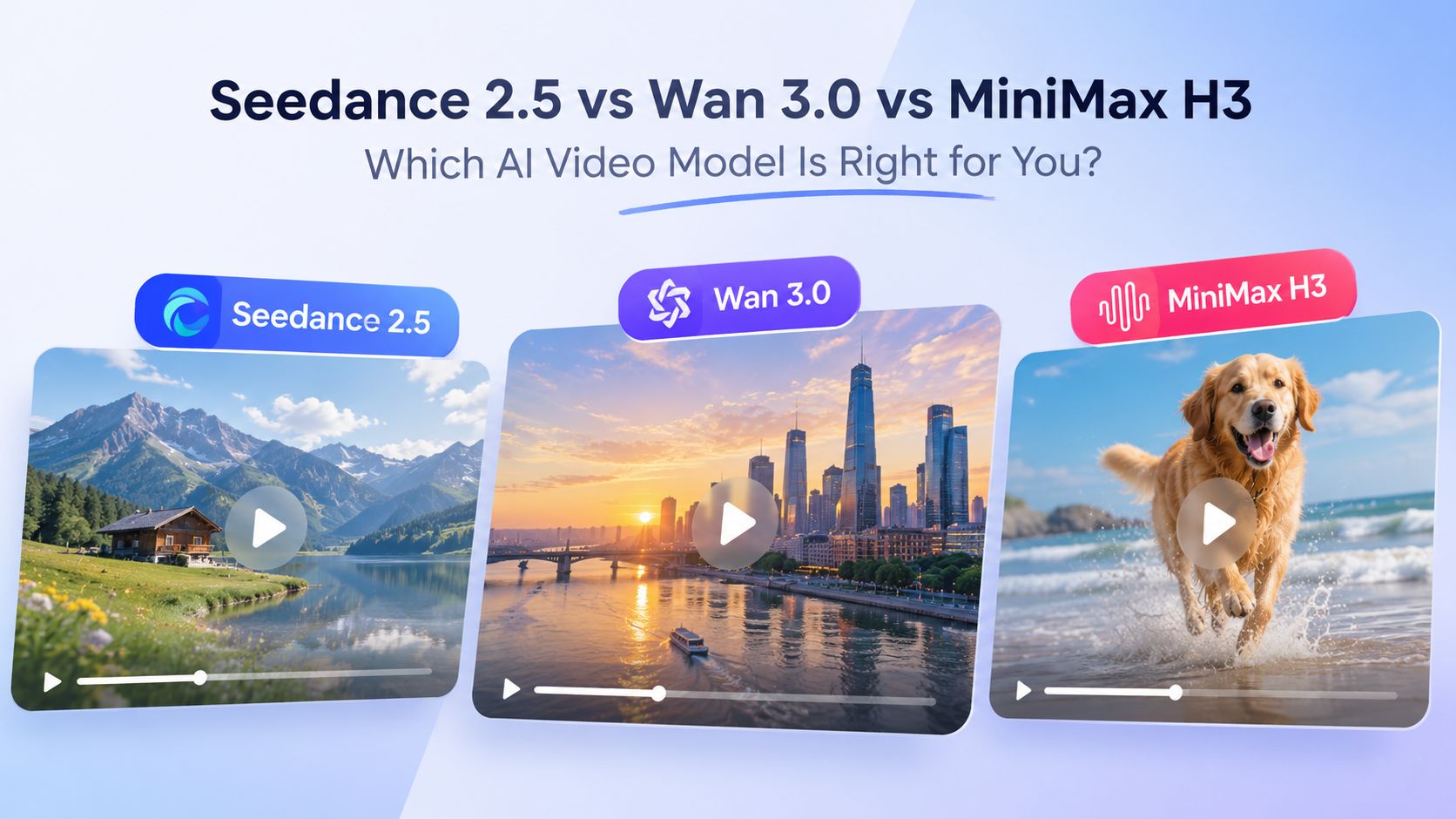
If you’ve been following AI video lately, you’ve probably seen Seedance 2.5 and MiniMax H3 everywhere. Both models arrived with a lot of hype, and both look seriously capable—but once you get past the demo clips and spec sheets, the obvious question is: which one is actually better to use? Seedance 2.5 is pushing longer videos, stronger reference control, and more consistent visuals, while MiniMax H3 brings native audio, flexible editing, and aggressive pricing into the mix. We tested them side by side across real video-making scenarios to find out where each one shines, where it struggles, and which model makes more sense for different types of creators.

Table of Content
Seedance 2.5 vs MiniMax H3 at a Glance
MiniMax H3 has quickly gained attention for its lower cost and strong value, while the newly released Seedance 2.5 is pushing longer generation, higher quality, and more creative control. On paper, both sound impressive—but how do they actually compare in real use? Let’s start with the key differences side by side.
|
Feature |
Seedance 2.5 |
MiniMax H3 |
|
Max Video Length |
Up to 30 seconds |
Up to 15 seconds |
|
Max Resolution |
Up to 4K |
Up to 2K |
|
Multimodal Input |
Text, image, video, audio, and up to 50 references |
Text, image, video, and audio |
|
Native Audio |
Supported |
Native stereo audio |
|
Reference Control |
Strong multi-reference control for characters, products, style, and scenes |
Multimodal reference control with V2V Motion Transfer |
|
Video Editing |
Localized scene and object editing |
Multimodal editing and in-context regeneration |
|
Key Strength |
Longer videos, high resolution, and reference-heavy creation |
Audio, editing flexibility, and cost efficiency |
|
Pricing |
Varies by platform and generation settings |
Positioned as a lower-cost model, especially at 2K |
|
Best For |
Ads, product videos, longer stories, and consistency-heavy projects |
UGC, audio-driven videos, editing, and budget-conscious creation |
Seedance 2.5 vs MiniMax H3 Pricing
Price is where MiniMax H3 immediately gets interesting. Based on current API pricing and public cost estimates, H3 can generate a 10-second 2K video for around $1.30, while a comparable 10-second Seedance 2.5 generation is estimated at roughly $2.30 even at 720p.
|
Model |
10-Second Cost |
Pricing Reference |
What You Get |
|
MiniMax H3 |
~$1.30 |
2K API rate at ~$0.13/sec |
2K output, native stereo audio |
|
Seedance 2.5 |
~$2.30 |
Estimated from public 720p generation examples |
Longer generation, advanced reference control |
That gives MiniMax H3 a clear cost advantage, especially if you generate frequently or need several attempts to get the right result. The comparison isn’t perfectly apples-to-apples—H3’s figure is based on 2K API pricing, while the Seedance 2.5 estimate comes from 720p public examples—but it still shows how aggressively H3 is priced.
Seedance 2.5 costs more, so the real question is whether its longer generation, stronger reference control, and consistency can make up for that difference in actual results.
Seedance 2.5 vs MiniMax H3: Real-World Performance
How We Tested
We used the same type of scene and prompt for both models, with MiniMax H3 shown on the left and Seedance 2.5 on the right. Each comparison runs for around 30 seconds and was exported at 1280×720, 30 fps for easier side-by-side viewing.
Rather than judging the models only by how cinematic a single frame looks, we focused on five things that actually affect whether a generated video is usable:
- Character consistency from shot to shot
- Whether actions are clear and feel physically connected
- Spatial relationships between characters and the environment
- Whether camera changes help move the scene forward
- How naturally effects such as fire, smoke, and energy blend into the scene
Test 1: Red-Haired Warrior vs Lava Monster
For the first test, we placed a red-haired female warrior on a damaged bridge facing a giant lava-covered creature. It is a demanding scene because the model has to handle character consistency, creature scale, close combat, smoke, fire, and environmental destruction at the same time.
MiniMax H3 keeps the action easy to read. The positions of the warrior, monster, and bridge remain clear, so it is easy to understand who is attacking and how the character is moving. The camera stays relatively restrained, which also prevents the subjects from getting lost behind smoke and effects. That makes the result useful when you need a clean standalone action shot—such as a dodge, attack, character pose, or interaction that can be dropped directly into an edit.
Seedance 2.5 pushes the scene further. Instead of simply showing the two characters fighting, it builds more progression into the sequence with close-ups, attack-and-defense changes, explosions, smoke, and damage to the bridge. The result feels closer to a short cinematic action sequence with a beginning, escalation, and payoff. The trade-off is that once the scene becomes this busy, fire and smoke can occasionally hide smaller character details, so you may need to pick the strongest moments from the final clip.
Verdict: MiniMax H3 is easier to use when you want one clear, self-contained action. Seedance 2.5 is more compelling when you want the conflict itself to develop into a larger cinematic sequence.
Test 2: Pink-Haired Character vs Giant Gorilla
The second test moves the action into a city street, where a pink-haired character faces a giant gorilla. This scene adds another challenge: the model has to keep the scale between the character, creature, buildings, cars, and street believable while also integrating energy effects into the environment.
MiniMax H3 establishes the scene quickly and clearly. The character usually remains near the visual center, while her hairstyle and outfit stay easy to recognize even with a giant creature in the frame. Viewers can immediately understand the subject and the threat. That directness works well for social clips, ad creatives, or short shots that need to communicate the main action within a few seconds.
Seedance 2.5 takes a more cinematic route. The sequence moves from an energy beam and character close-up into a larger attack, with more changes in framing, angle, and visual effects along the way. Rather than simply showing “character fights gorilla,” it tries to build rhythm and a visual climax around the event. That makes it more suitable for trailers, character-introduction videos, and story-driven shorts, although the extra camera and scene complexity also means you need to watch more carefully for continuity issues.
Verdict: MiniMax H3 is better at making the action immediately understandable. Seedance 2.5 is better at making the scene feel bigger and more developed.
Seedance 2.5 or MiniMax H3: Which Should You Choose?
The choice mainly comes down to what matters more in your workflow.
Choose Seedance 2.5 if you want:
- Longer videos up to 30 seconds
- Stronger multi-reference control
- Better consistency for characters and products
- Higher-resolution, production-focused output
Choose MiniMax H3 if you want:
- Lower generation costs
- Native audio and stronger audio workflows
- Faster, cheaper experimentation
- A more budget-friendly option for frequent video creation
For creators who simply want the best value per generation, MiniMax H3 is easier to recommend right now. But if your project depends on longer scenes and precise reference control, Seedance 2.5 can still justify the higher cost.
FAQs
Is Seedance 2.5 better than MiniMax H3?
Not in every category. Seedance 2.5 is better suited to longer videos, reference-heavy workflows, and consistency-focused projects, while MiniMax H3 has a stronger advantage in pricing, native audio, and cost-efficient iteration.
Is MiniMax H3 cheaper than Seedance 2.5?
Based on current pricing references, yes. A 10-second MiniMax H3 generation is estimated at around $1.30 at 2K, while public Seedance 2.5 examples put a 10-second generation at roughly $2.30 at 720p. The comparison is not perfectly like-for-like, but H3 currently has the clearer price advantage.
Which model is better for realistic human videos?
Both can produce realistic human scenes, but Seedance 2.5 has an edge when character consistency and reference control are important. MiniMax H3 remains a strong choice for shorter human-centered videos, especially when audio and cost matter more.
Which is better for ads and product videos?
Seedance 2.5 is generally the stronger choice for product-focused and branded videos because longer generation and multi-reference control make it easier to preserve product details and visual identity. MiniMax H3 can be more practical for producing multiple ad variations at a lower cost.
Which model has better audio?
MiniMax H3 has the advantage here thanks to its native stereo audio support. If dialogue, sound effects, or audio-video synchronization are central to your workflow, H3 is the more attractive option.
- Which is better for beginners, Seedance 2.5 or MiniMax H3?
MiniMax H3 may be easier for beginners who want to experiment without spending too much, while Seedance 2.5 is better suited to users who are comfortable working with references and more detailed creative control. - Which model is better for professional video production?
Seedance 2.5 is generally the stronger option for more production-focused workflows, especially when longer clips, visual consistency, product accuracy, and multi-reference control matter. MiniMax H3 is still attractive for professional creators who prioritize fast iteration, native audio, and lower costs.