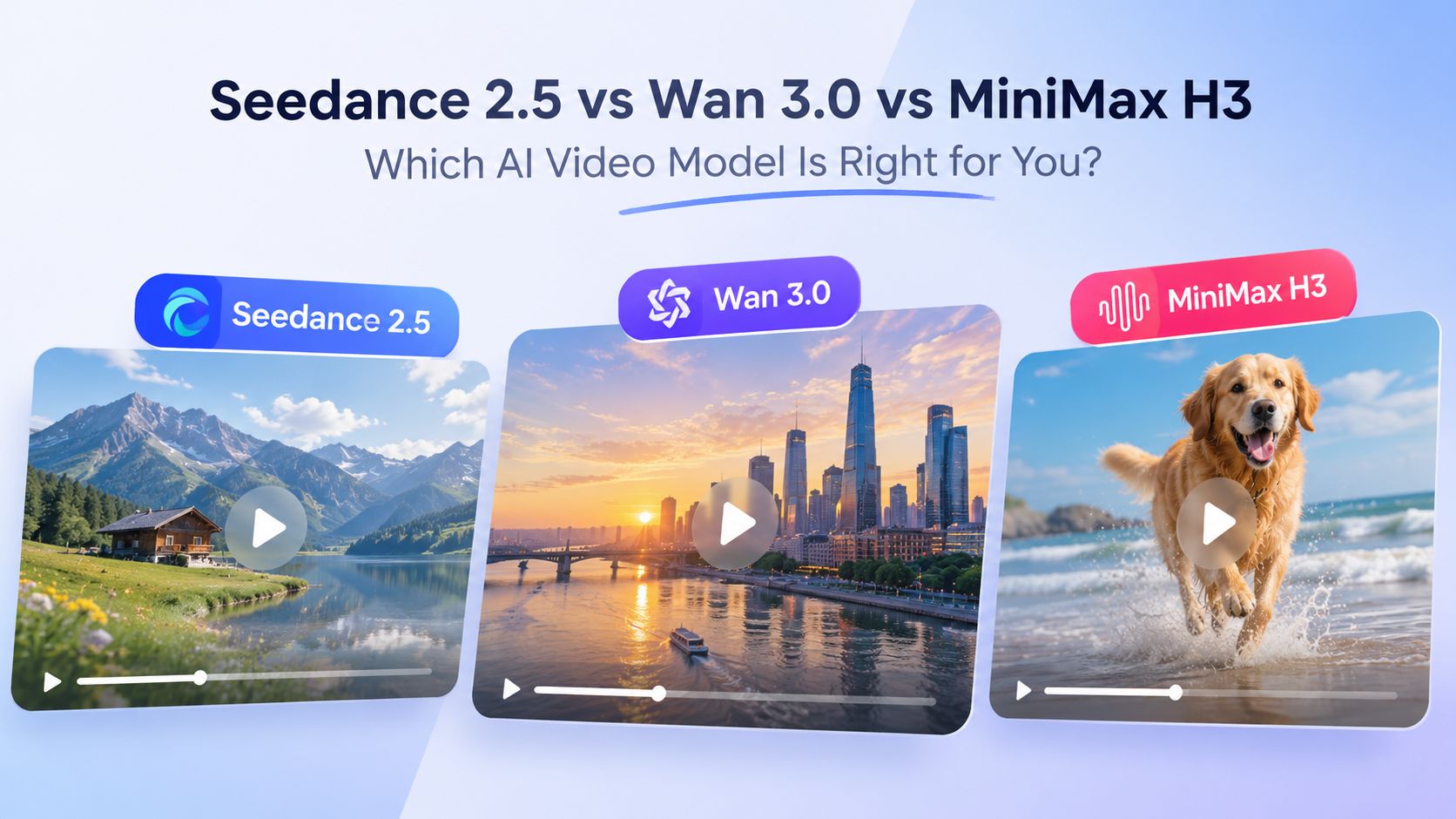
Kling 4.0 vs Seedance 2.5 vs MiniMax H3: The Real-World Verdict
Kling 4.0 is fully deployed, but does it live up to the marketing claims? Here is a no-nonsense, head-to-head breakdown compared to Seedance 2.5 and MiniMax H3, complete with testing prompts to run your own benchmarks.

Table of Content
Kling 4.0 is finally live, but can it actually outperform Seedance 2.5 and MiniMax H3 to become the top AI video model of 2026?
This time, we are putting the issue everyone cares about most—pricing and budget—right up front. Before we even look at the visual quality, let's break down the official API generation costs so you can see exactly how far your budget will stretch.
I. API Pricing & Cost Breakdown: Setting Expectations
| AI Model | Base Resolution (480p–768p) API Cost | High Resolution (1080p–2K) API Cost |
| MiniMax H3 / H3-Max | $0.05/sec (480p) – $0.08/sec (768p) | $0.13/sec (2K) |
| Kling 4.0 | $0.113/sec (720p) | $0.170/sec (1080p) |
| Seedance 2.5 | $0.140/sec (480p) – $0.315/sec (720p) | $0.790/sec (1080p) |
Note: Pricing reflects official base API rates without video reference inputs.
Looking at the numbers, MiniMax H3 is the undeniable champion of cost efficiency, offering native 2K output for less than what competitors charge for 720p. Kling 4.0 sits comfortably in the middle, providing a solid balance for standard 1080p narrative projects (and offering a very affordable 10 credits/sec rate if you use their official subscription platform). Seedance 2.5 commands a steep premium, especially when pushing 1080p—making it a much heavier investment per shot.
Keep these numbers in mind as you review the real-world tests below. Do they deliver true value for your money? We tested all three models using the exact same prompts on AIReel to give you an authentic, side-by-side look at how they handle cinematic visual quality, complex action sequences, and nuanced emotional dialogue.
II. Action and Camera Movement
1. Large-scale camera movement test prompt:
Epic wide shot of a massive sandstorm approaching a lone desert outpost at dusk. Camera starts low and slowly rises into a sweeping crane shot, then orbits around the outpost as the storm hits. Strong wind, flying debris, dramatic volumetric lighting, dust particles interacting with the structures, cinematic scale, stable long take, no cuts.
Real performance of Kling 4.0:
Real performance of Seedance 2.5:
Real performance of MiniMax H3:
Seedance 2.5 delivered the strongest overall performance in this scene, particularly in simulated camera shake and the sense of pressure created by the push-in. Kling 4.0 handled atmosphere and cinematic mood very well, successfully conveying a feeling of isolation. MiniMax H3’s result was comparatively ordinary.
2. Close-quarters fight test prompt:
Intense close-quarters fight between two martial artists in a rainy alley at night. One character dodges a high kick, counters with a spinning elbow, then both exchange rapid punches and grapples. Dynamic handheld camera following the action, water splashing, realistic impact physics, cloth and hair movement, continuous motion without freezing, cinematic action choreography.
Real performance of Kling 4.0:
Real performance of Seedance 2.5:
Real performance of MiniMax H3:
Kling 4.0 showed clear improvement in fight scenes. Camera movement tracked the characters’ actions effectively. Seedance 2.5 remained excellent, especially in fight rhythm, action continuity, and the sense of physical contest between the two fighters. MiniMax H3 limited the action mostly to hand movements and used a single, static camera angle.
III. Emotion and Dialogue
1. The Micro-Expression Prompt:
A realistic 10-second cinematic close-up two-shot of a young woman and a young man sitting across from each other in a quiet café by the window on a rainy afternoon.
0–2s: She looks down at her phone and receives a text message. Her expression is neutral. Soft natural window light, shallow depth of field.
2–5s: Her expression slowly shifts from neutral to subtle surprise. A faint blush appears on her cheeks as she tries to hide a small smile.
5–8s: He notices her reaction. He raises one eyebrow slightly and leans forward a little with a soft, knowing look. Their eyes meet briefly.
8–10s: She glances up at him for a moment, then looks back down, still trying to suppress the smile. Delicate micro-expressions, realistic skin texture, restrained emotional performance, no exaggerated acting, continuous take.
Real performance of Kling 4.0:
Real performance of Seedance 2.5:
Real performance of MiniMax H3:
Kling 4.0 performed at a high level here. Eye contact and interaction details between characters were richer and better matched the subtle romantic atmosphere described in the prompt. Seedance 2.5 was slightly less natural in how the two characters’ expressions connected with each other, though individual facial detail remained strong and the color grading felt more cinematic. MiniMax H3 was respectable but still lagged in realism and fine detail.
2. The Fast-Paced Drama Prompt:
A realistic 12-second cinematic medium shot of two close friends arguing heatedly in a small apartment living room at night.
0–3s: The woman is frustrated and speaking quickly: “You always do this! Every time you say it’s fine, and then what?” Clear lip sync.
3–6s: The man is defensive but trying to stay calm, raising his voice slightly: “I didn’t mean to, can you just let me finish?” Natural overlapping energy.
6–9s: She cuts him off, eyes flashing with anger mixed with hurt. Her body language becomes more tense.
9–12s: He takes a short breath and lowers his tone slightly, still defensive but softening. Continuous take, realistic room lighting, accurate lip sync in English, clear emotional shifts in facial expressions and body language, no exaggerated acting.
Real performance of Kling 4.0:
Real performance of Seedance 2.5:
Real performance of MiniMax H3:
Kling 4.0 handled character interaction a bit unevenly. The female character’s sense of rejection and negative emotion felt less convincing because of imperfect body language — for example, a forward step during the argument appeared slightly out of place in the scene.
Seedance 2.5 managed the mutual defensiveness and emotional distance more effectively, and the silent pause at the end felt natural. Surprisingly, MiniMax H3, which underperformed in earlier tests, conveyed the intensity and confrontation of the argument quite well in this case.
IV. Technical Specs: What’s Under the Hood?
Here is a quick snapshot of their core specs and feature limits:
| Feature | Kling 4.0 | Seedance 2.5 | MiniMax H3 |
| Max Duration | 3–30s | 4–30s | 4–15s |
| Resolution | 720p / 1080p / 4K | Up to ~1080p | 768p / 2K |
| Dynamic Range | 10-bit HDR | 10-bit | Standard |
| Keyframe Control | Up to 10 frames | Primarily first/last frame | First/last frame |
| Multimodal Refs | Up to 15 (10 img, 5 vid, 7 subjects) | Up to ~50 items | ~12 items |
| Audio & Voice | Stereo, massive lip-sync upgrade | Native audio generation | Native stereo |
| Core Strength | Narrative, micro-expressions, lighting | Long takes, dynamic action | High ROI, 2K shorts |
Cinematic Color & Texture Test Prompt:
To see which model gives you that high-end, commercial-grade look for your money, copy and paste this prompt:
Cinematic product showcase of a luxury perfume bottle on a reflective black marble surface. Soft volumetric golden hour light from the left, subtle dust particles floating in the air. Slow orbiting camera, rich saturated colors, deep shadows with retained detail, high dynamic range, film grain, 10-bit HDR look, ultra-realistic reflections and caustics.
Real performance of Kling 4.0:
Real performance of Seedance 2.5:
Real performance of MiniMax H3:
Kling 4.0 stood out clearly in fine detail and lighting texture. Seedance 2.5, however, better conveyed an overall sense of luxury. MiniMax H3 produced a result that felt closer to a product still, but it introduced unmentioned product labels — a reminder that prompt precision matters more with this model.
V. Final Thoughts
After side-by-side testing, the differences are clearer.
Seedance 2.5 remains strongest in large-scale camera movement and action. It delivers more forceful camera work, better fight rhythm, and a stronger sense of physical contest. It also edges ahead in conveying a polished luxury feel.
Kling 4.0 has improved meaningfully in the areas many users cared about most. It leads in micro-expression detail, eye interaction, and atmospheric storytelling. Lighting texture and fine detail are often its strongest points, and camera tracking in fight scenes has clearly improved. Body language in emotional dialogue can still feel slightly off at times.
MiniMax H3 stays the high-value option. It rarely tops the others in cinematic quality or complex motion, and sometimes adds unrequested elements. Still, it handled emotional intensity surprisingly well in the drama test and remains practical for cost-sensitive or high-volume short-form work.
Quick recommendations:
- Choose Seedance 2.5 for camera movement, action, or a luxury aesthetic.
- Choose Kling 4.0 for micro-expressions, subtle emotion, atmosphere, or lighting detail.
- Choose MiniMax H3 (or Kling Flash) when budget and volume matter more than peak quality.
There is no universal winner. The best approach is still to run the same prompts and judge against your own needs.
AIReel fully supports Kling 4.0, Seedance 2.5, and MiniMax H3 in one unified interface. Head over to AIReel, test these exact prompts on each model, and see which one delivers the best return on investment for your creative workflow.
Happy creating, and we look forward to seeing what you produce!